Pages

Showing posts with label gardening. Show all posts

Saturday, May 7, 2016


This little fellow looks just like the picture (out of focus) I took of the bee on my walk.
It came from the web, credit to keepingbee.org.

 It's been a long time since the last post. Lots of reasons, none of them particularly good.

It appears that the weather is going to be less than perfect again this year. Is my memory of spring accurate? Was it so much better when I was a child? So much more delineated as a season in my youth? I think it was. For sure, the bees weren't dying off then.

I found one on the front walk today. A honeybee dead. Was it lured out with the little bit of warm weather we've had and then not able to find enough food when the weather turned cold and rainy again? Or was the bee killed because the firm that takes care of the lawns uses a toxic herbicide? Or is there some sort of infestation in the hive where the bee resided? Whatever the reason, it was sad to see.

Spring is when things are  supposed to start blooming and thriving. Not dying. I hope it isn't a precursor of what's in store...

Sunday, February 7, 2016

Deconstructing grocery shopping

I went grocery shopping
Grocery shopping still conjures up images of me 50 years ago accompanying my mother to multiple stores, all small by today's mega-store standards. We would go up and down the aisles and she would purchase thing things that spanned a variety of categories: produce, fruit and meat (typically fresh), milk, ice cream, cottage and other cheese (even though we lived next door to a dairy farm and had previously had milk delivered), bread (typically day old because it was less costly), canned foods (beans, tomatoes, soups, etc. because they could be kept and used quickly - e.g. no soaking beans overnight), cake and pizza mixes, frozen TV dinners and pot pies (it was the time convenience foods were getting a foothold in the stores).  Rarely if ever do I recall purchasing fish other than during Lent and the fish were frozen sticks. I didn't like them. Although my mother cooked from scratch, canned and preserved it never occurred to me to question that these new, sometimes tasty, labor-saving foods might not - in the long haul - be good for all us eaters. We humans have a little problem with thinking about "the long haul." Over time food producers of all kinds researched the heck out of what we wanted (not thinking about what we might need) and food became saturated with synthetic (as well as natural) preservatives and additives that led to foods that were high in flavor and calories and low in nutritional value. I may be a member of the last generation to remember the groceries that primarily stocked other than highly processed food rather than fresh ingredients.

Fast forward to today. The choices are often mega-stores or specialty stores (like Trader Joe's). Then there are health food stores (which I'm sure were around 50 years ago but they were mostly vitamins and supplements, not food.) If you are in a progressive area, you may be able to shop at a co-op and get largely organic, vegetarian and vegan food with an emphasis on health. And then there are farmers markets. These have always been there but often obscure from visibility and perceived as for people with money. People have offered food items for as long as they moved away from everyone hunting and gathering on their own. It was only with the advent of the industrialization, mechanization and concentration of food growing and production that this practice began to wane. But it's rebounded as people want to know more about what they eat and are rediscovering the difference between a tomato bred for shipping and a tomato bred for flavor.

It didn't come from Walmart
So, rather than going to mega-stores for the convenience of one-stop shopping, or buying highly processed "industrial" foods that abound, I'm drawn the small shops that celebrate the skills and flavors that I almost let slip away from me as I grew up. When I ask about an item I find myself often listening in awe to young people who create or grow food using skills that I might have dismissed as too much work or beyond my abililty. And I remember my elders and am grateful.

Monday, July 6, 2015

Nice confusion


Recently I had a slightly confusing Twitter exchange with this book's publicist about it winning an award. Actually it was the Gold Winner in Juvenile Nonfiction awarded by Foreword Reviews and their Indiefab Awards. Foreword Reviews is another interesting story...
 
It's not my book.  Unfortunately I had nothing to do with it, but am delighted for the confusion so that I know it's out there. Continuing to educate children about the importance of what we eat, where it comes from and how to prepare it are all good. 

To learn more about the book, click here.

Sunday, March 29, 2015

This doesn't make sense


Right on the heels of my post about permaculture, a long-view approach to a respectful relationship with the natural resources around us, and one that admittedly requires curiosity, patience, humility and real, hard work, I ran across a magazine article that stopped me. In the past I might have regarded the gardening tips in the article more benignly. But not now.

I won't mention the magazine because it doesn't matter. The information provided isn't materially different from what other magazines or websites on creating pleasant home and garden environments might offer. But the content of one tip in particular caused me to stop in my tracks. The tip, quoted verbatim below is:

"Step up to better soil. Raised beds can be filled with the very best topsoil so you don't have to spend years improving difficult ground. Traditional wood beds are fine, but composite decking boards and rusted steel are decorative and durable."

Yes! Better soil! No! Not that way! We can't continue to buy our way into growing sustainably. We need to do the  work of rebuilding our resources. The answer isn't for big companies to improve soil so they can scrape it into bags I buy. Its my responsibility to take care of the bit I have and create more and better soil. And I believe it's everyone's job. We've forgotten that, or become disconnected from it or call it what you will, but I believe we all decide to do the necessary work and forgo immediately gratifying gardens, we're just kidding ourselves.

The Land Institute has been working for decades to improve soil by researching and promoting polyculture (growing multiple crops/rotating them) rather than the monoculture that has overtaken US agriculture. They also promote perennial grains (like the grains that grew before modern farming) rather than the annual crops that the vast majority of farmers grow. This big-scale solution can be applied in container gardening as well. Paying attention to how we treat our soil and improve it rather than replacing it every year and starting fresh feels more responsible. More sustainable. More right. 

What to do besides supporting the Land Institute's work? Start composting. Have your yard soil tested and work to bring back its health naturally. Grow plants that help the soil and each other. Fertilize and deal with pests and plant diseases naturally. Help support pollinators. Yes, it's work. Worthy work. Satisfying work. Necessary work. And work that won't wait.
When people, land, and community are as one, all three members prosper; when they relate not as members but as competing interests, all three are exploited. By consulting Nature as the source and measure of that membership, The Land Institute seeks to develop an agriculture that will save soil from being lost or poisoned, while promoting a community life at once prosperous and enduring.” - See more at: http://www.landinstitute.org/about-us/vision-mission/#sthash.uUh0m7ZH.dpuf

Friday, March 27, 2015

Change that makes sense

One of the many posters in the Lexicon of Sustainability


An email landed in my inbox today from the folks at the Lexicon of Sustainability. I got acquainted with their work a couple of years ago and have been a fan ever since. They tell the story of sustainable food, growing, practices - you name it - so that people are using a common language when they talk. And hopefully, then, when they understand the issues they face. 

This poster on permaculture was explained as being a shift in thinking and living. A stepping back to see the really big picture. It said:

The word ‘permaculture’ comes from the melding of two words: ‘permanent culture’ and ‘permanent agriculture’,” points out Rhamis Kent. “It’s something that’s able to sustain itself by the very nature in which it’s constructed. As Bill Mollison says, ‘It’s the harmonious integration of landscape and people providing their food, energy, shelter, and other material and non-material needs in a sustainable way.’" Learn how permaculture is not just a sustainable agriculture method, but a lifestyle for many.

Makes sense to me.

Sunday, September 28, 2014

The Important but Not Urgent


I did it again. I forgot what is really important. Doing and pursuing things that are urgent but not important has led me down paths that, when I look back, I think "why did I do that?" Or worse, "what a waste of time" or "I didn't even enjoy it." I've done this over and over. And every time I think I've learned my lesson, at some future point I find that the learning didn't stick. It's happened again.

Last fall I was so "busy" I forgot to plant my fall crop of garlic. And this year my gardening took a back seat to other things. I'm not sure exactly what took its place, but something did. No doubt something that screamed "urgent!" And so when I got my last tomato CSA yesterday, it struck me that another summer (of which there are only a limited number left) was gone and I'd not enjoyed my garden as I had in past years. I didn't give much to it and it didn't give much to me. Fair and tremendously unsatisfying.

Then I looked at some tomatoes, a few peppers, a bit of fruit and flowers sitting on my counter and was content again. The garden's bounty may not have cheered me during the growing season, but all that beauty sitting on my counter reminded me of that planting and tending my food is one of the most important things in my life. It's nothing to be missed.Actually, nothing that satisfying could be more urgent.

Saturday, June 28, 2014

Feeding a Memory


I spent this morning the way I imagine my grandmother and my mother spent their days.
They cooked.
Every day.
From scratch.

But today I really tried to think about my grandmother - a woman I barely remember who lived with us for a few years until her death - and how her days were spent, caring for a house, and cooking for a husband and seven children. I was thinking about a particular time in her life, the summer of 1937. The first summer after my grandfather had died, but while several of her children were still at home. 

I started by going to my deck garden (she would have gone to her garden behind the house on 10th Street in the southwest Indiana town) and gathering a few things for today - kale, greens, chives, tarragon - then watering in advance of a hot day. Her garden was likely fenced against animal intruders. Mine is relatively untouched even in an area where heron are seen at the pond a few yards away, deer wander across nearby streets and packs of coyotes have been spotted in my little Michigan town.

After putting away my harvest (I'm am confident my grandmother had an icebox since my grandfather had been stationmaster for the Pennsylvania Railroad and could afford modern conveniences), I decided to bake. Logically she would have baked early in the day, before the house heated up. Baking was hot work without air conditioning, mixers, food processors and likely with poorly insulated ovens. Late in the day a kitchen might be hotter than it was outside, depending on where it was located in the house and if there were trees shading it. But cooking needed to be done because the other option was eating at a restaurant. More importantly, I think, in that time and in my mother's as well, cooking was expected.

I used a recipe on a worn 3x5 inch recipe card written in my mother's handwriting, making "Apple Sauce Cake De Luxe" clearly noted as "Mrs. Bartholome's". Although my mother was "Mrs. Bartholome" too, there was no mistaking that this was my grandmother's recipe.

The cake called for unsweetened applesauce which she would have very likely made previously. My mother made applesauce from Transparent apples, one of many varieties in our backyard. Fortunately I've found a source for those same apples and pulled a jar of last year's applesauce from the pantry. 

The recipe didn't mention icing so I left the cake un-iced. I wanted the first taste to spur a memory of my grandmother or at least of having had this handed down recipe cake as a child. After it cooled, I cut a square and prepared to be transported. Nothing. The cake was good, really good. A neighbor on whose porch I'd left some while it cooled wrote an email to rave about it. I would make it again and enjoy it. But I can't use it to call up the memory I wanted. Yet, I still feel connected and that I know something about my Grandmother because of making that cake. I'd had the recipe forever but never made it. Now I have the memory of making it in honor of her and of my mother who preserved it.

In addition to applesauce, it has cocoa, nutmeg, cinnamon and more spices. I didn't follow the recipe exactly since they don't make Spry anymore, but I think my grandmother would have liked mine as much as I liked the experience of making it.

Here is the recipe just as it was handed down:

1/2 c. Spry
3/4 tsp. salt
1/2 tsp. cinnamon
1/2 tsp. cloves
1/2 tsp. nutmeg
1/2 tsp. allspice
2 Tbsp. cocoa
1 1/2 c. sugar
2 eggs unbeaten
1 1/2 tsp. soda
2 c. sifted flour
3/4 c. dates, chopped
3/4 c. raisins, chopped
1 1/2 c unsweetened applesauce
3/4 c. nuts, chopped

Blend Spry, spices and cocoa. Add sugar gradually and cream well. Add eggs singley, beating after each. Add soda to flour and sift three times. Sprinkle 2 Tbsp. flour over fruits. Add remaining flour to creamed mixture alternately with applesauce, mixing after each addition until smooth. Add nuts and floured fruits to batter and blend. Bake in 10x10" greased pan. 55-60 minutes at 350 degrees.

Sunday, November 10, 2013

Confused Flora


I believe in climate change. I have for a long time. Although I don't have deep technical, scientific knowledge of the issue, I don't know that I need it to see an impact close to home. The potential for radically changing the growing season. In my lifetime.

For several seasons an arrow-head type plant in my front garden has grown far too late into the season after having died out and assumed that the brief cold snap was winter and the sure-to-be brief warm snap justified popping up out of the earth again.

But today, while walking, I saw what is in the picture above. Buds on a nearly dead rose bush, on November 10th. Buds sitting side by side with massive rose hips from dead roses and spotty leaves that appear just about to give up the ghost. Clearly the plant seems pretty confused. If roses are confused it's sad. If food crops are confused, and don't fully complete their growth cycles, then what?

Monday, November 4, 2013

Pop up poster show - Day 2


The first seasonal (Fall) show of Lexicon of Sustainability posters ended and quietly disappeared, leaving no physical trace of its presence. No trash. No damage. A simple end.

However it did leave some things behind. It left an energy behind to continue lots of conversations with new connections. And it left other people with next steps for projects in their backyards that promote local, sustainable food. And too, it sparked ideas for how people could work together to get more done collaboratively than they could alone, all without reinventing wheels. The two-day show was a start. It's up to everyone to keep the momentum going.

Watch the Art of Sustainability Facebook page for information on where you can see more posters at the Winter Pop Up Show.

Sunday, November 3, 2013

Pop up poster show - Day 1

One of the posters from the show November 2 -3, 2013 in Three Oaks. More information here.


Yesterday was the first day of the Lexicon of Sustainability pop up poster show in Three Oaks. The weather - sadly - didn't cooperate. It was mostly drizzly and got colder over the day. Overcast, dull and gray. Yet there were some hardy folks who came out to see the show and talk to those of us who were there. And in the venues, Edington Gallery and Pleasant House, chance patrons who knew nothing about the show saw it, engaged with it and perhaps one of the hosts. And so it starts.

Then a few of us stayed to continue the conversation around the Viking Table at Journeyman. 

Today, we start again. It's sunny and promises to be warmer for the show's second day. Fingers crossed for a bigger crowd and more conversations. The topic is important. Although the show had no specific outcome in mind other than focusing attention on the importance of our local food system and the meaning of sustainability, that itself is a big goal.

Today at 6pm the show disappears (although the issues it raises don't.) But mark your calendar for the next pop up show - January 18 and 19 at Journeyman - and more terms from the Lexicon of Sustainability. In the meantime, you can contribute to the conversation at the Art of Sustainability Facebook page (link is above under the image...)

Sunday, December 30, 2012

Whatever's available


I've had pasta sauce on my mind for a couple of days now, so decided to make some. I was determined not to go to the grocery, but to make the sauce with what I had. I was delighted to find that I had put away a whole bag of onions (crucial to pasta sauce for me) and of course I had plenty of tomatoes that I'd canned. So I dived into making what is a true comfort food for me. The aroma of pasta sauce simmering on the back burner for hours is delightful on a cold, snowy day. And the fact that I made it with what I had (substitution is a fine art that should be embraced) was even better.

Growing up pasta sauce was made a very specific way with ground beef and while I still like that version, if you don't have ground beef, you can still make the sauce. I know my mother wouldn't think so, but you can. It won't taste the same, but if it tastes good, isn't that ok? Not that traditional tastes should be left behind, they shouldn't! But we can be creative and economical and make tasty food without having to go to the grocery for special ingredients all the time. Eating from the pantry and the freezer makes so much sense to me. It's an enjoyable challenge to see what results and if it makes sense to document the recipe or continue tinkering.

Today's effort is on the recipe page.

Sunday, July 29, 2012

The New Old-Fashioned Approach to Canning


Canning is sustainable, right? It takes the available bounty and preserves it for the off season. It reuses jars again and again, eliminating purchases of "canned" goods whose containers are either recycled (if possible) or end up in the land fill. All good. And of course canned foods are satisfying in a way that only things you make yourself ever are. They are the product of your labor, represent your tastes and make wonderful, always-appreciated gifts. But...

Canning takes a lot of water. Washing the produce, sterilizing the jars, boiling water baths for processing and maybe even boiling water to add to the jar as in cold packed tomatoes. And then there are the lids. Every year they need to be replaced. In the old days women (women did most of the canning) knew how to conserve water because they had to, living off wells, and the canning jars and lids were glass, so unless broken, they weren't discarded. Yes, we've come a long way in terms of canning technology, but we (at least I feel I) use more water and hate throwing out those lids after a single use. So I reverted back to some old-fashioned simple ways to be more sustainable. 

First I reused the water in the big water bath kettle. I had always done this when doing multiple batches of processing on a single day, but this year I saved the water over night and reused the next day. No reason it (it seems to me) it couldn't be saved for several days in high canning season, adding to it as it depletes rather than starting new every time. It seems obvious, yet there was the competing need to clean up the kitchen after canning (using yet more water than necessary.) Now I no longer do that, saving at least 10s of gallons of water. It's not hard to leave a full water bath on the stove.  

Then there are those lids. I ran across some reusable canning lids in Mother Earth News but upon checking them out, decided they were too expensive. A knee-jerk reaction to a cost today that saves cost over time, perhaps. But I couldn't get it out of my mind that they were a wiser, sustainable thing to use, rather than throwing out all those lids as I canned more and more. So I gave in and purchased their starter pack (free shipping) that got me three dozen each of regular mouth lids and wide mouth lids. That many one-time lids would be approximately $18. These were about $50. But it would take only three uses (not years!) for them to pay for themselves and I've been known to put up things in the dead of winter. So I would quickly come out ahead. I will know how they work in terms of keeping food as I open what I've canned, but so far so good.  They can be found at here

It feels good. My canning is now much more sustainable and economical. No question there is still more I can do. I'll continue to work on that. 

Monday, June 18, 2012

Learning about life from my garden

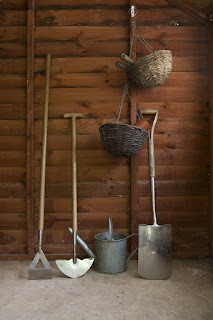
Tools for life lessons


A number of years ago - probably nearly 20 now - who can keep track? - a woman shared a bit of wisdom with me about life lessons. Always one to collect quotes or brief snippets that appealed to me, I kept it. It was:


RULES FOR BEING HUMAN
1. You will receive a body.  You may like it or hate it, but it will be yours for the entire period this time around.

2. You will learn lessons.  You are enrolled in a full-time informal school called life.  Each day in this school you will have the opportunity to learn lessons.  You may like the lessons or think them irrelevant and stupid.

3. There are no mistakes, only lessons.  Growth is a process of trial and error and experimentation.  The "failed" experiments are as much a part of the process as the experiment that ulti­mately "works.”

4. A lesson is repeated until learned.  A lesson will be present­ed to you in various forms until you have learned it.  When you have learned it, you can then go on to the next lesson.

5. Learning lessons does not end.  There is no part of life that does not contain its lessons.  If you are alive, there are lessons to be learned.

6. "There" is no better place than "here.”  When your "there" has become a "here,” you will simply obtain another "there" that will again, look better than "here.”

7. Others are merely mirrors of you.  You cannot love or hate something about another person unless it reflects to you some­thing you love or hate about yourself.

8. What you make of your life is up to you.  You have all the tools and resources you need.  What you do with them is up to you.  The choice is yours.

9. Your answers lie inside you.  The answers to life's questions lie inside you.  All you need to do is look, listen and trust.

10. You will forget all this.
Author unknown, found on a refrigerator in Toronto

The most memorable zinging words were, "you will forget all this." Thus the need to be open to "relearning" perhaps in new, deeper ways the basic lessons of life, of which, I've decided there are too many to count on both hands. 

And so my garden has become my latest and possibly most patient and determined teacher. Clearly I am in need of a refresher coure in life lessons I'd forgotten I forgot, or perhaps ones where I haven't received the passing grade that will let me move on to the next lesson. 

When I started my garden a few years back in just a few months I had studied:
  • patience
  • understanding when enough is enough
  • planning
  • collaboration
  • sharing
  • tenacity
  • peacefulness
  • satisfaction
  • curiosity
  • acceptance and 
  • adaptability. 
In no particular order these lessons popped into my consciousness like sprouts that push throught hte earth. One minute nothing is there, the next there is a fresh budding insight, to be nurtured and fed. Hopefully to develop into a fully formed healthy insight that can be appreciated and savored. 

I've learned patience in many ways, the obvious, waiting for seeds to sprout, the less obvious waiting for weather to accommodate my desire to plant NOW! Trying to move tender greenhouse started seedling outside because I'm ready risks losing all. Obvious enough yet when impatience is at its height, it can be almost painful the waiting, the "doing nothing" (As if waiting for the proper conditions weren't work) that is required of successful gardeners. Not satisfied with the growth in the greenhouse, when the calendar said Spring, I ignored the wisdom of experience gardeners and seed packet instructions and started to move things outside because I was ready to experience my perception of being a gardener. Needless to say the poor things suffered with cold snaps. Pricy oca, organic pepper starts and flowers (cosmos and chrysanthemums) all had their leaves bleached white with cold. They struggled because of me but managed to live, stunted perhaps but at least there. 

That was the first year. Since then I've following the lead of the weather rather than feeling like I need to bend it to my will. I've asked for and been given help and advise (gardeners are the original collaborative spirits I've decided) and I've not given up when various pests and blights have occurred, but tried to outwit them without using chemicals, getting more and more curious about how they occur and how to quell them. And I've accepted the inevitable when there have been failures, ripping out one thing and planting something else, adapting to the world as it is.

My garden has taught me in ways that people couldn't. A garden has no intention but to grow, unlike people who may have intentions that frustrate ours. Listening to the lessons that it teaches has been much easier (and more true) than listening to people who I could watch do just the opposite. 

There are more lessons in my garden. I've passed it's first round of tests and am moving on...

Monday, January 2, 2012

Winter finally arrived

While it won't be a major storm, in terms of snow depth, winter has finally arrived with a temperature drop, slick roads and a blustery, blowy snowy gray day. It's time. Celery on my deck that should have long since gone dormant was apparently growing quite nicely thank you. Ornamentals that bloom in spring near my front door were hardily big-leafed. I have been concerned that my 100s of bulbs of garlic, planted (in theory when the time was right) would be growing and then get snapped into senselessness when it did finally turn cold. I don't think the garlic broke the ground, but in all honesty, haven't looked for the last 10 days because I couldn't do anything about it if it had.

We've slipped into the time of year when seed catalogues give hope of the bounty to come. But more and more weather is less dependably cooperative than I remember it being in years past. There have always been droughts, floods, late summers and early winters. But the violence of the weather in the recent past is frightening. Gardeners who eschew chemicals fertilizers and weed control are regularly given lessons in humility by Mother Nature. I think we are heading into a future of graduate classes. I hope I pass.


Friday, August 5, 2011

You Get What You Pay For

Much has been written about the cost of food on all fronts. That it will cost more as the price of oil goes up. That is is artificially low in this country thanks to subsidies, and that food grown without chemical fertilizers or herbicides costs more because it is more labor intensive, or small scale, or both. 

In the August/September issue of Mother Earth News there is a short article in the Green Gazette column with a headline "Choose Local Food and Save!" It cites research - several studies - that show that at least some, if not all items are less costly at farmers' markets. They are also likely much fresher and more nutritious. And because the money goes directly to the grower, they are helping boost the local economy as well. Rather than growers selling mass quantities of produce in bulk and getting a small percentage of the retail price, selling at a local market allows them to get more fully compensated for the risk, the work and the results. 

As consumers we can choose to pay a lower retail price (and possibly a higher one in terms of our nutrition and health) or a higher price (and improve our nutrition and health). As they say, you get what you pay for.

Saturday, July 23, 2011

The bees that are left need to fear thieves

According to an article in the New York Times, thieves are stealing all sorts of farm produce in California (and elsewhere no doubt!) including even the bees. This was the first I'd known about such things, although I guess it shouldn't surprise me. People steal what's valuable and as we transition to whatever is next in terms of our financial state as a country, food will become more and more valuable - and costly. I guess this is just a different manifestation of that...


See the entire article:

Published: July 21, 2011
With strong harvests, and reduced crime-fighting budgets, thefts of farm products have risen in California’s rural areas.

Monday, July 18, 2011

Reclaiming the specialness of eating in season


Recently at a family reunion my cousin served a fabulous corn/zucchini casserole dish. It was the hit of the dinner and everyone asked for the recipe. Being a family of cooks and eaters, we all wanted to recreate it and enjoy it again. It would be particularly good in the dead of winter, and rather than buying imported corn and zucchinis, I decided that I would explore how to create this dish so that it could be canned and then re-heated. I knew I could freeze it, but I had my doubts about the texture after freezing and also wanted to see lovely jars of summer on my shelves.

We're just coming into corn and zucchini season so my timing was spot on. But I didn't know how to convert the recipe into one that could be canned - I didn't think it should be cooked as long because it would cook in the canning and then again when reheated. So I contacted Lori Evesque who was my instructor in a pressure canning class last fall. She's a food scientist as well and I was sure she'd know the answer.

She did. It's not something that can be canned successfully.

Lori explained why - the dairy wouldn't hold up, the amount of cooking would leave the veggies overdone and there wasn't enough liquid in the recipe to successfully can it. In short, it would be a disaster. That's when it occurred to me that I was guilty of trying to have my cake and eat it too.

As much as I try to each seasonally, its clear that I wanted to eat what I wanted when I wanted it. If I use local produce at its best, then I can only enjoy it fresh for a few months in the summer. Then I will need to wait until next year to enjoy it again in such dishes. How nice! Something to look forward to...something that truly is and remains special. It was good to be reminded of what I already knew but hadn't taken fully to heart. That if we can have anything we want any time we want it, then absolutely nothing is special any longer.

Here's to special dishes enjoyed at the top of the season and canning what can be done well to enjoy in those months between. Thanks Lori!

Friday, July 8, 2011

Time to change the law...

I received the message below on one of the food lists I'm on. Seems silly. Once it may have made sense, but I'm not sure when that would have been...

COPY OF MESSAGE

I received this new article from one of our UC Irvine Community garden
members.  I am president of the community garden here in SoCal.

A woman in Oak Park has had a new sewer dug and replaced her lawn with
vegetables.  According to this news report, she is having to fight the
City Council and risks jail time.

Oak Parks City Planning and Technology Director is Kevin Rulkowski.

The city website is:
http://www.oakpark-mi.com/technical_planning/index.asp

I plan to call Mr. Rulkowski and weigh in to this situation.  If members
of the Michigan sustainable agriculture community will also voice their
opinions, I am sure that it will have more significant impact.

http://www.theagitator.com/2011/07/07/does-michelle-obama-know-about-this/


Thanks
Lu Forrest
--
Lu Forrest D.V.M.
285 Irvine Hall
Department of Physiology and Biophysics
University of California, Irvine
Irvine CA  92697-4561

Thursday, June 23, 2011

No more bees' knees...


Or wings, or stripey little bodies. If you hadn't heard, there is a  huge problem of honeybee colony collapse. And without bees' knees bending and sipping that nectar, not only will there be no honey, but there will be no anything that requires pollination to produce. And I truly don't think the answer is to find a way to grow things without pollinators. There is a reason - a PROBLEM - why hives are collapsing and I hope that the people who are hard at work find a solution that saves bees, honey and, in the end, the security of our food supply!

Read about it here. And consider, that this problem is occurring everywhere.  It is happening around the world as shown in the article from Great Britain where the lovely photo above appears....click the link under the photo for more information - particularly the 10 things that children can do to help honeybees (a PDF file).

Sunday, June 19, 2011

Edible Michiana

Good news food lovers! We are about to have our own magazine devoted to food! Long in coming, perhaps, given that Michigan is the state that taught California how to grow produce. But, nonetheless, the magazine, Edible Michiana is about to launch here in the heartland. The premiere issue will be available July 1 and quarterly after that. In my opinion it is long overdue and welcome. While the awareness is growing about the area I live in as a wonderful agricultural area, there is still too much farmland being lost to development. This is an area that is worth visiting precisely because of what ISN'T here. It's not quite lost to chains, water parks and mega stuff. Not yet, but it's still possible that this fertile, beautiful contributor to our tables could be. Let's hope not.

Look for Edible Michiana and see what's here...