Pages

Showing posts with label ingredients. Show all posts

Sunday, February 7, 2016

Deconstructing grocery shopping

I went grocery shopping
Grocery shopping still conjures up images of me 50 years ago accompanying my mother to multiple stores, all small by today's mega-store standards. We would go up and down the aisles and she would purchase thing things that spanned a variety of categories: produce, fruit and meat (typically fresh), milk, ice cream, cottage and other cheese (even though we lived next door to a dairy farm and had previously had milk delivered), bread (typically day old because it was less costly), canned foods (beans, tomatoes, soups, etc. because they could be kept and used quickly - e.g. no soaking beans overnight), cake and pizza mixes, frozen TV dinners and pot pies (it was the time convenience foods were getting a foothold in the stores).  Rarely if ever do I recall purchasing fish other than during Lent and the fish were frozen sticks. I didn't like them. Although my mother cooked from scratch, canned and preserved it never occurred to me to question that these new, sometimes tasty, labor-saving foods might not - in the long haul - be good for all us eaters. We humans have a little problem with thinking about "the long haul." Over time food producers of all kinds researched the heck out of what we wanted (not thinking about what we might need) and food became saturated with synthetic (as well as natural) preservatives and additives that led to foods that were high in flavor and calories and low in nutritional value. I may be a member of the last generation to remember the groceries that primarily stocked other than highly processed food rather than fresh ingredients.

Fast forward to today. The choices are often mega-stores or specialty stores (like Trader Joe's). Then there are health food stores (which I'm sure were around 50 years ago but they were mostly vitamins and supplements, not food.) If you are in a progressive area, you may be able to shop at a co-op and get largely organic, vegetarian and vegan food with an emphasis on health. And then there are farmers markets. These have always been there but often obscure from visibility and perceived as for people with money. People have offered food items for as long as they moved away from everyone hunting and gathering on their own. It was only with the advent of the industrialization, mechanization and concentration of food growing and production that this practice began to wane. But it's rebounded as people want to know more about what they eat and are rediscovering the difference between a tomato bred for shipping and a tomato bred for flavor.

It didn't come from Walmart
So, rather than going to mega-stores for the convenience of one-stop shopping, or buying highly processed "industrial" foods that abound, I'm drawn the small shops that celebrate the skills and flavors that I almost let slip away from me as I grew up. When I ask about an item I find myself often listening in awe to young people who create or grow food using skills that I might have dismissed as too much work or beyond my abililty. And I remember my elders and am grateful.

Monday, July 6, 2015

Nice confusion


Recently I had a slightly confusing Twitter exchange with this book's publicist about it winning an award. Actually it was the Gold Winner in Juvenile Nonfiction awarded by Foreword Reviews and their Indiefab Awards. Foreword Reviews is another interesting story...
 
It's not my book.  Unfortunately I had nothing to do with it, but am delighted for the confusion so that I know it's out there. Continuing to educate children about the importance of what we eat, where it comes from and how to prepare it are all good. 

To learn more about the book, click here.

The price of healthy food

--> Everyone knows that healthy food is expensive. But why does it have to cost more for food with fewer additives, less processing and fewer food miles than it does to eat industrially produced food that is nutritionally questionable at best? It never made sense to me. And now I find there is a "fast food" restaurant just down the street that is healthy and locally sourced where possible.
Open less than a week when I visited, this little take-out storefront operation serves up a wide variety of freshly made wraps using good ingredients and many house-made items. The portions are generous and the food is really tasty. And it was surprisingly inexpensive. For less than $10 two people can have a nice lunch (excluding beverages) that is both well made and healthy. Yum. Let's do more of this, please.

Just as cooking at home doesn't need to be hard to do or fancy, this concept is simple at its core. Home cooking and healthy "fast food" both require focus, commitment and time. So there is a choice. What's yours?

Tuesday, May 20, 2014

In season


Thanks to Wikipedia for the image. A description of rhubarb is in the link below.


It's finally getting around to being the kind of weather than reminds me that I live in a very productive growing area. The question is, will the weather continue to support the kinds of things that are planted around here and have made their homes here for generations? Or will the changing climate cause radical shifts in what can be sustainably grown here? I don't know....worry about yes, but actually know, no.

For now, I'm going to focus on the positives. The first being, the rhubarb is in! And this year rather than make it into a typical crumble dessert or a spread for toast - both of which I grew up with - I decided to try something different. I wanted to taste pickled rhubarb and after looking through several cookbooks, decided to go to the local guru who pickles anything that will stand still long enough - Joe Lindsay of David's Deli.

Without hesitation he shared a recipe that was immediately at his fingertips. And I came home and made a small batch of the best tasting stuff I've had in a long time. Quick and easy. No processing since they are refrigerator pickles. I bow before the master, but if I do say so myself, mine are pretty darn good.

Here's what I did with Joe's recipe that he calls Rhubarb Mother Pickle.

1 lb rhubarb
1 cup vinegar
1 cup water, tea, etc.
1 cup brown sugar
1/2 cup dried fruit
1 tablespoon main spice
1 teaspoon secondary spice

Cut cleaned rhubarb into desired size pieces. Place in a bowl, sprinkle with salt and let stand at least an hour. The longer the salt is left on, the more water will be removed. (I stirred the rhubarb a couple of times to get the salt to cover all the pieces.)

Drain and rinse the rhubarb and place into jars that can be tightly sealed. Leave a little space between the top of the rhubarb and the lid. Set aside unlidded.

In a small pan, boil together all remaining ingredients. When boiling, carefully add to the jars of rhubarb, covering the rhubarb. Put lids on and set aside to cool. Store in refrigerator.

Most refrigerator pickles will keep about a month.

In my version:
The vinegar was apple cider vinegar infused with tarragon; the main spice was a Royal Curry Powder; and the secondary spice was allspice. The options are endless, but the rhubarb isn't. Give some a try and see what you think. Enjoy the season while you can.


Sunday, November 18, 2012

Pumpkin cake for the current me


I love pumpkin. Growing up I couldn't get enough of if, because it seemed that the only time we had anything pumpkin was between about mid-October and Christmas. Which, by the way, is historically the season to have pumpkin unless you canned it. Commercial canning and out of area growing made year-round pumpkin even more possible. Of course now what is labeled pumpkin may actually be a winter squash mix....but I digress.

After leaving home decades ago I found that pumpkin wasn't just for that tiny window and so started collecting pumpkin recipes. One of my favorites was a pumpkin cake that had orange juice and orange zest in it. It was heavenly and I made it often, even adapting it various ways. Time passes and for whatever reason, that recipe was replaced by others. But when invited to a dinner last evening, I decided it was a perfect time to bring that wonderful pumpkin cake as a dessert. So I dug out the recipe and rolled up my sleeves yesterday morning to make the cake.

HORRORS! I read the recipe and it called for a stick of butter in the cake AND a stick of butter for the frosting! Had I really eaten that? Yes I had, and loved every minute of if. Today though, I don't eat so much fat (or try not to) for various reasons. And I don't even try to fool myself into thinking I can do it occasionally. Of course I can, but I don't want to. So what to do?

My solution was to leave the butter in the frosting since I didn't have a good idea of what might substitute (sorry - fat free creme cheese doesn't do it). That left the batter. Often I've used apple sauce to replace a fat in baking. So this time I used some recently canned pear sauce (just like apple sauce only I think a milder flavor) and wondered what would happen. Yes, it's risky to try new things when you are bringing a dish to a dinner, but why not get feedback from people who you know enjoy and know food? So I dove in and made the recipe with the substitution.

At dinner I didn't say what had changed in the recipe, only let people know there had been a change and asking for their thoughts. Seriously, there were moans of "yum" "ooohh, this is so good" and the like. I actually thought they were putting me on so I tasted it. It was good - very moist and delicate and 50% less fat than the original recipe. I learned that I can use pear sauce just as well as apple sauce and not risk so much at all. And since I made the pear sauce with pears from a nearby friend, I knew it didn't have gobs of sugar or anything else in it either.

I've shared the recipe on the Recipes page of this blog. I apologize in advance because I don't know where the original one came from. But with this adaptation, I guess it becomes mine :-)


Friday, May 25, 2012

Oh, come on already!


Sometimes it seems that people don’t agree for the simple, and in my view perverse, joy they appear to take in disagreeing. What is the big deal about labeling food that has GMO ingredients? Alarmist, they say? If I want to know what I’m putting in my mouth, that’s unreasonable? Big food companies have been putting all kinds of things in my mouth for a long time. Yes, perhaps they are on the package, but if I’m not a chemist, botanist, a food scientist or a particularly curious person, I probably don’t know what they are. When we grew or raised what we ate, we knew. Yes, we needed to get more efficient and grow farming to feed the people. What we didn’t need to do was lose the connection between people and their food that we’ve managed to lose in the process. 

Its time to make that reconnection and it needs to be made in many ways. This is one. We need to give people a true choice of what they choose to eat.  If you don’t want to eat GMO foods and I do, we should be able to make that choice. If I want to save seed and you want to grow GMO crops, you shouldn’t be able to sue me if my seed becomes “contaminated” with genes from yours, or vice versa. Food prices, well, there is another sticky wicket. And an important one that must be addressed. But allowing information about if a food includes GMO ingredients, that seems to be a simple choice.

From today's New York Times:


Concern over the possible health and environmental effects of such food has prompted a move for labeling it, but scientists, farmers and technology companies call the measures alarmist.


Thursday, March 22, 2012

Tasting local

I'm not in a big city, and I've always believed that you don't have to go to one for wonderful, tasty things. In the past, most communities had their own breweries, their own bakers, their own butchers and growers of all things edible. We got away from that and food production got concentrated in the hands of a few and standardized into oblivion. Now control is being taken back by people who want the joy crafting wonderful foods and beverages on a smaller than national scale.

In May and June Edible Michiana magazine and Garden to Table are co-sponsoring workshops celebrating the blend of craft spirits and local foraged items and garden items to make delicious cocktails. Cocktails that would stand up to anything that the big city has to offer. 

For more information, see the current issue of Edible Michiana (click on the image of the magazine on the left), page 7 for the ad. To register, visit the Edible Michiana website - registration is right on the home page. Hope to see you there!


Wednesday, February 22, 2012

How to cook...


Although I find it hard to believe, I know it’s true that lots and lots and lots of people don’t know how to cook. Or think it is too difficult to do. Or say they don’t have the time to do it. It saddens me that they may never know the joy of walking into a kitchen redolent of simmering onions and bacon, or for the vegetarians, a pasta sauce slowly cooking on the back burner. Or the aroma of homemade cookies in the oven. Somehow between the 1960’s and 1980’s cooking became verboten for anyone who had a modicum of cool (not entirely true but you get my point) and then suddenly celebrity chefs made it cool again to cook, but not every day. And that revived version of cooking required shiny new pans, equipment, togs etc. to complete the look. It became a fashion statement that could cost a lot of money to do the “right” way.
Not for me. I cook every day. I use some of the same utensils that my mother used in her kitchen more than 50 years ago. They work just fine and bring back memories of her. I have some modern conveniences as well, but do just dandy without lots of specialty gizmos. And cooking allows me to know – to the extent possible – what is in the food I put in my mouth. And when friends come over, you know as well as I do that people congregate in the kitchen for a reason – food and food preparation nurtures our spirits and our bodies. And there is something so incredibly satisfying about really making something whether it is a meal, a bookcase, a knitted scarf or a painting. I consider all of them works of creativity and art….
Three "cooking spoons" from my mother's kitchen
The Good Guide (online and through a Smart Phone app) allows you to find safe, healthy, green and ethical products based on scientific ratings. Recently they showed that leaving processed food behind isn’t as hard as it might seem to those who didn’t grow up cooking. Five tips from their website blog are below.
5. Soup. These recipes and strategies for making soup, courtesy of Mark Bittman, will make you say goodbye to canned soup forever. Too difficult? Consider recommendations from GoodGuide.
4. Pasta Sauce. The jarred versions may seem really convenient, but there’s just something about the smell of bubbling tomato sauce that can’t be beat. Here are recipes for a Five-Minute Sauce and Tomato Vodka SauceToo difficult? Consider recommendations from GoodGuide.
3. Granola. The options are endless when it comes to making your own granola. Hate raisins? Don’t put them in. Love sunflower seeds? Throw in an extra handful. Get some ideas from this AllRecipes listToo difficult? Consider recommendations from GoodGuide.
2. Yogurt. You’d be amazed at how simple it is to make your own yogurt. The best part? Making your own cheese is only one more step. Too difficult? Consider recommendations from GoodGuide.
1. Pasta. It might sound labor-intensive, but there’s no comparison between fresh, homemade pasta and 

the boxed stuff. Learn how to roll your own with this video from our friends at CHOW. Too difficult? 

Consider recommendations from GoodGuide."


My two cents on the whole topic of cooking: If you don’t cook, try it. If you do cook, cook more. There is nothing to lose and lots of goodness and satisfaction to gain.

Friday, November 11, 2011

Worth following

I've added another blog to the list of ones I'm following. Does the writer have a point of view? Absolutely. An axe to grind? Maybe. But he writes clearly and there are some interesting links to sources and even a bit of wry humor to make his medicine about the food supply go down a tad easier.

To check out his Halloween post about processed foods yourself, click here.


Friday, September 23, 2011

Vegan Diet - a primer

In anticipation of our guest blogger, Kat Barry of Kat's HOT Cakes, next month, here is a quick primer on what it means to eat according to a vegan diet. Kat will be blogging about how to eat vegan on a budget.


Thursday, September 22, 2011

What's in a name....really, what is?


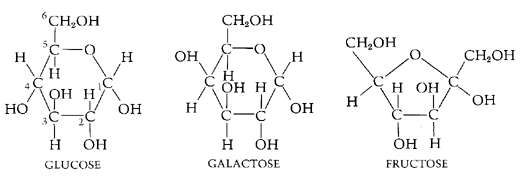
This morning's Good Guide email had a squib from their Blog talking about the battle brewing over a  food-based version of the memorable past discussion about what "is" is....in this case, the meaning of the word "sugar." It may seem obvious, but it's more than semantics....it's about what and how we eat and who's calling the shots.

Read the entire article.

PS - the chemical compounds above are all sugar, glucose, galactose and fructose...

Friday, September 9, 2011

Smarter Shopping - maybe...


Because of some work I do I receive an enewsletter from "the Supermarket Guru" every day. I've occasionally shared tips or news from it. Today's edition touted a new iPhone app to help make cooking and shopping smarter and less costly. Sounded good and I'm sharing it in the spirit of promoting better eating.

However, a warning first. The application was developed in partnership with ConAgra Foods which is one of the largest, processed food conglomerates in the US. It has had its share of critics for its various activities including support of GMO products. Caveat emptor - or in this case, free iPhone app user, beware...

Friday, August 19, 2011

The $5 Challenge

I've long believed that the idea that eating well couldn't be done on a budget was somewhat incorrect. Certainly if you had no access to healthy food then no matter how much money you had, it wouldn't matter. But assuming you have the access to choose healthy over not healthy, it seemed that the bigger issue was the perception that there wasn't time to cook, or perhaps, there weren't the skills.

To cook - like many other things in our Western culture - is a choice. If we don't "want" to cook or "like" to cook we don't have to. It wasn't always that way and still isn't in many other parts of the world (and truthfully, in many parts of the US as well.) To live is to cook...or if you eat only raw foods, at least to prepare them if not alter them with heat. Yet in the last 30+ years we seem to have left cooking to others, too busy with "important" things to do it. But maybe the tide is shifting as "cooking" takes on a new chic face with shows, competitions and attention by marketers. Yet, at it's heart, cooking is about sustaining life, building community among friends and family and - at least for me - it's a meditation on the amazing variety, taste, aroma and beauty of all the ingredients as well as the finished product.

How we view cooking - as drudgery to be left to others or as something that doesn't fit into a busy day -  has consequences. Both financial and health related. And the money we spend on it doesn't have to break the bank to be tasty or more nutritious. Slow Food, the movement that began as a reaction against "fast food," has set out The $5 Challenge to encourage cooking and reeducate us that eating well doesn't have to be expensive. In the process, hopefully people will begin to rediscover there is a joy in cooking (a tip of the hat to Irma Rombauer...) and in the results. Even if things don't work out quite the way the recipe shows, unlike with other mistakes in life, with cooking most times we can really eat our mistakes :-)


Friday, August 12, 2011

Separating out the cream

I grew up next door to a dairy farm in Southern Indiana and routinely found myself in the milking barn and the room where the big chiller held all the milk til the tanker trucks came to take it away. Early on my family's milk was delivered in bottles (I don't know if it was from the farm next door) and it was whole milk (not 2% or skim) that I drank with my meals and my mother cooked with. Over time we got our milk in cartons and they said "pasturized"  and "vitamin D added" and these were perceived to be good, healthy things. Now they are called into question.

There has been growing interest in using raw milk. Yet as recently as the 1930's tainted milk products were the largest source of food borne illness and so the move to pasturize them was perceived as a health boon. Does using raw milk make sense now? I admit I've used it to make cheese (I can no longer drink whole milk of any kind because its just too rich) and enjoyed it. And know of parents whose children drink it to gain weight for sports. Yet, as in all parts of life, risks are out there and there are people who have suffered from it.

The website Real Raw Milk Facts is one source of information. Raw Milk Facts is another. (Perhaps the former was a "response" to the latter?) There are probably lots more. Like many important things, the solution is probably not a simple black/white issue. These websites may or may not support your views on the topic, but at least they identify themselves in the debate. What is right for one person may not be right for another, however becoming more informed seems to be a good thing for everyone.


Sunday, July 24, 2011

How we got here, dietwise

Much has been written about how poor the average American's diet is. Growing up in the 50's and 60's we ate at home. My mother cooked every day, baked, canned and froze all types of garden abundance and only at Christmas did we have soft drinks in the house. That made them a treat and signaled family parties and gifts. Now soft drinks are a daily staple, choices of all types of food abound and people's lives are too hectic and busy to cook, except perhaps on holidays. That's when all the stress comes out anyway, so if you aren't attuned to cooking, it makes holiday cooking even more difficult to manage. For at least a decade before he died in 2002, my father talked about how "fat" everyone was. He was very observant and wise.

How did a nation of farmers, attuned to the seasons and careful to preserve what was available for times when it wasn't, shift into the anytime, anywhere, cheap food noshing people that so many do?  Here's a timeline that tells the story.

Thursday, June 23, 2011

No more bees' knees...


Or wings, or stripey little bodies. If you hadn't heard, there is a  huge problem of honeybee colony collapse. And without bees' knees bending and sipping that nectar, not only will there be no honey, but there will be no anything that requires pollination to produce. And I truly don't think the answer is to find a way to grow things without pollinators. There is a reason - a PROBLEM - why hives are collapsing and I hope that the people who are hard at work find a solution that saves bees, honey and, in the end, the security of our food supply!

Read about it here. And consider, that this problem is occurring everywhere.  It is happening around the world as shown in the article from Great Britain where the lovely photo above appears....click the link under the photo for more information - particularly the 10 things that children can do to help honeybees (a PDF file).

Saturday, December 11, 2010

Eating isn't optional

I've had the opportunity to have a number of conversations recently with people who care passionately about the food they eat and how it was raised. Interestingly, these are people who came to these positions (and in two cases, to producing their own foods at least in part) by somewhat different routes, but they share a conviction of not going back to "the way things were." They have made conscious choices and are committed to standing by them.

Food and food choices are important for a number of reasons - but none more succinct than one that occurred to me a while ago. And that is: eating isn't optional. We all have to do it. We need nourishment every day or certainly quite regularly if we are to live. Nothing is much more basic than that unless it's air and water. Food can be tasty or bland, nutritious or junk. It can be fresh or stale, prepared or raw (at least in some cases...), local or from a foreign country. And for all the choices we seem to have about the foods we eat in this country, we actually don't have too many unless we grow our own food.

With the limited varieties of produce that is grown to withstand shipping and the incorporation of corn and soy in products of all kinds we limit ourselves. By eating prepared foods rather than cooking from scratch, we limit ourselves. By choosing the familiar and not taking a chance on a new vegetable, we limit ourselves. And by buying food based primarily on price in the big markets we further limit our choices because we miss out on what smaller growers and producers may be offering. No question it is a challenge in these times to stretch budgets for food as well as everything else. But although you don't have an option of whether or not to eat, if you have the option to choose healthier, tastier, more nutritious food, why not?  

Tuesday, July 20, 2010

As good as cherries?

All my life I've loved cherries. Cherry anything. Waiting for fresh cherries each year was a trial. Not having the place for my own tree (past the one in yard of my childhood) was punishment. Then a few years ago I saw ground cherries listed in a seed catalogue.


They couldn't be as good as cherries, but then I still didn't have room for a tree. Or the patience to wait for one to grow even if I had the room.

This year I decided to try them. The plant is in a bit of an inopportune place, thanks to an error in judgment on my part and an amazing growing season. It is shaded a bit by towering tomatoes yet it is bushing out and set lots of cherries. They look strangely like tomatillos as they grow on this shrub.

Time came for a taste test. I can see now that the one I tasted wasn't fully ripe, yet it was - while not at all cherry-like in taste - quite true to the description in the catalogue: clean and citrusy. Immediately I knew I had a new ingredient to work with and began to consider how to use my harvest (which will be small).  I still love cherries now have added this variety to the list: Bing, Ranier, Sour and Ground.

How many plants have we lost the opportunity to taste and enjoy and be creative with? Yet another reason to seek out and try the new as well as plant the old favorites.

Saturday, July 17, 2010

Ingredient "pellets"

Recently I was in the presence of some people who do "food science". The term "pellets" was used to describe an ingredient in a mass produced food product. The first thing that came to my mind was the poison that was used to kill rats - pellets.


      Then I thought of food pellets for animals and fish.


Never did it occur to me that the food products for human consumption were made using anything but raw ingredients. (And of course, depending on what one buys, the required litany of multi-syllabic, tongue-twisting chemicals.) Naive of me wasn't it?  I'm sure it's much less costly to transport pellets of dehydrated stuff (e.g. tomato sauce) than all the tomatoes, onions, garlic and other ingredients of tomato sauce, but somehow it just seems wrong. Think about it. Tomatoes on the vine, processed into sauce, then dehydrated, bagged and shipped who knows where to be rehydrated into something that probably has the words "natural" and "fresh" on the label. Why not just make the sauce and be done with it? Why transport twice?