Pages

Wednesday, February 22, 2012

How to cook...


Although I find it hard to believe, I know it’s true that lots and lots and lots of people don’t know how to cook. Or think it is too difficult to do. Or say they don’t have the time to do it. It saddens me that they may never know the joy of walking into a kitchen redolent of simmering onions and bacon, or for the vegetarians, a pasta sauce slowly cooking on the back burner. Or the aroma of homemade cookies in the oven. Somehow between the 1960’s and 1980’s cooking became verboten for anyone who had a modicum of cool (not entirely true but you get my point) and then suddenly celebrity chefs made it cool again to cook, but not every day. And that revived version of cooking required shiny new pans, equipment, togs etc. to complete the look. It became a fashion statement that could cost a lot of money to do the “right” way.
Not for me. I cook every day. I use some of the same utensils that my mother used in her kitchen more than 50 years ago. They work just fine and bring back memories of her. I have some modern conveniences as well, but do just dandy without lots of specialty gizmos. And cooking allows me to know – to the extent possible – what is in the food I put in my mouth. And when friends come over, you know as well as I do that people congregate in the kitchen for a reason – food and food preparation nurtures our spirits and our bodies. And there is something so incredibly satisfying about really making something whether it is a meal, a bookcase, a knitted scarf or a painting. I consider all of them works of creativity and art….
Three "cooking spoons" from my mother's kitchen
The Good Guide (online and through a Smart Phone app) allows you to find safe, healthy, green and ethical products based on scientific ratings. Recently they showed that leaving processed food behind isn’t as hard as it might seem to those who didn’t grow up cooking. Five tips from their website blog are below.
5. Soup. These recipes and strategies for making soup, courtesy of Mark Bittman, will make you say goodbye to canned soup forever. Too difficult? Consider recommendations from GoodGuide.
4. Pasta Sauce. The jarred versions may seem really convenient, but there’s just something about the smell of bubbling tomato sauce that can’t be beat. Here are recipes for a Five-Minute Sauce and Tomato Vodka SauceToo difficult? Consider recommendations from GoodGuide.
3. Granola. The options are endless when it comes to making your own granola. Hate raisins? Don’t put them in. Love sunflower seeds? Throw in an extra handful. Get some ideas from this AllRecipes listToo difficult? Consider recommendations from GoodGuide.
2. Yogurt. You’d be amazed at how simple it is to make your own yogurt. The best part? Making your own cheese is only one more step. Too difficult? Consider recommendations from GoodGuide.
1. Pasta. It might sound labor-intensive, but there’s no comparison between fresh, homemade pasta and 

the boxed stuff. Learn how to roll your own with this video from our friends at CHOW. Too difficult? 

Consider recommendations from GoodGuide."


My two cents on the whole topic of cooking: If you don’t cook, try it. If you do cook, cook more. There is nothing to lose and lots of goodness and satisfaction to gain.

Sunday, February 19, 2012

A good glass of wine...


A friend, Greta Hurst of Tabula Rasa Gallery in Baroda, recently attended the 5th Annual Southwest Michigan Wine Evaluation at Lake Michigan College, Mendel Center in Benton Harbor. It was a serious, day-long event where Michigan wineries brought their wines to be blind tasted by 40 winemakers, chefs, restaurateurs, grape growers, wine enthusiasts, AND three highly trained sommeliers. Michigan wines have a reputation for being too sweet for serious oenophiles who historically have tended to dismiss them. They may need to rethink that.

Participants tasted 59 different wines grouped into ten varietals: Pinot Gris, Chardonnay, Gewurztraminer, Pinot Noir, Riesling, Merlot, Syrah, Cabernet Franc, Bordeaux Blend and Cabernet Sauvignon. Each category included at least one wine from outside the region as the benchmark for that particular varietal.

The goal:

  • to unemotionally evaluate local wines against a benchmark and provide consistent feedback to winemakers as they work to raise the bar on Michigan wine.

Bottom line? Tasters unanimously chose Michigan wines over benchmark wines every time.

I expect this was a lovely way to spend a day and appreciate learning of it from Greta. Hats off to Southwest Michigan’s wine country!


Tuesday, February 14, 2012

Continuing yesterday's conversation...


Ron's reply had a lot of "meat" to it and seemed to be quite a bit to "bite off" and address all at one sitting. (Ok, I'm done with the food references for now...)  I will take some time responding and will come back to it from time to time. To that end....

Ron noted his perception of the near calcification of the system since WWII. Bigger players, entrenched positions, lots of reliance on technologies that would seem to render real change unlikely as they could smack down annoyances. Yet, I'm not so sure. Lots of change is happening now because of technology and the speed with which a shared concern can be communicated and energy harnessed. Yet of course what looks like a quick action had lots of energy to go into it that wasn't visible too. Like the snow-bound pine branch that just sits and sits and sits with that mound of snow on it with nothing apparently happening, when the snow slides from the branches its likely from invisible melting that looks like a sudden change. 

Some examples:


  • Today's New York Times had an editorial about the strides made against childhood obesity by Michele Obama's "Let's Move" initiative and her planting of a garden on the White House lawn. It took decades for obesity to become a problem (those years between WWII and say the late 80s or early 90s). As recently as 2008 more than two thirds of American adults and one third of children were obese. What numbers! And while others were attempting to address this through the traditional channels - doctors warning patients, Jenny Craig touting diets, parents approaching schools to feed their children better and making "healthier" choices like shopping at farmers markets -  the conditions were shifting into place so that when the First Lady made obesity reduction her cause (and one I heartily support) it may have been that last little bit of sunlight that caused the avalanche. My cynical side says food companies saw the opportunity to make more money by getting in front of the parade through changing formulations to eliminate the "bad" ingredients. My optimistic side said that there were people in those food companies that genuinely believed that they needed to change, after all, they had children and grandchildren too and cared about their futures. It's not a black or white issue here. It's gray. In my ideal world, big food companies aren't necessarily always the problem, its how they operate and the choices they make that put them in the category of saint or sinner.
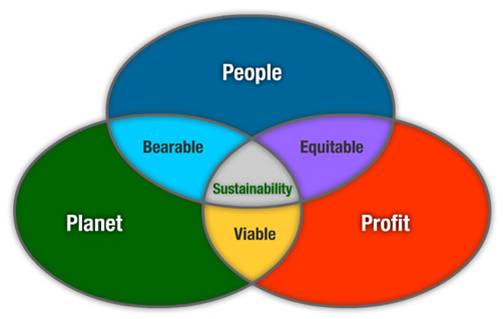
  • There is a bit of common wisdom that I believe has roots in science, which says that we see what we think about. Or said another way, we can't see what we don't think about. So it makes sense that someone like me sees lots of things going on in the world to change the relationship we have with food. But I know I have a lot of company from people concerned with the concept of sustainability which is bringing multiple disciplines together around issues that touch on food and more. This concept has been around for a long time, but again, people are able to more easily connect now and working collaboratively is more expected, since it's not possible to deal with complex problems in isolation. (Not sure it ever really was...)  Nearby the Center for a Sustainable Future (at my Alma Mater and my professor's former home Indiana University, South Bend Campus) is an example of this. Four years old, the center is a regional, cross-state-line effort to "... engage the campus and greater Michiana communities in creating a future focused on the "triple bottom line." Choices that are good for people and the planet, as well as profits, and that take into account ecological and social performance are promoted and encouraged by the Center." Everything is connected - food and manufacturing processes and HVAC and products used to clean the floors and health and more. Once things are viewed this way it makes it difficult to consider any one thing in isolation. Sustainability is the kind of framing mechanism that is giving this change legs. And sustainability too has economic benefits.
Sudden change takes a while. And looking at things as interconnected may help to move away from the win/lose, black/white mentality that has crept into so much of society. I'm hopeful that the conditions are such that rather than totally swallowing the efforts to change the current food system (some of which is inevitable) new recipes can be found that are beneficial to all. Call me Pollyanna. Others have. But things are happening. The key is to keep them moving.


Image from the website of The Center for a Sustainable Future, Indiana University, South Bend